In an article originally published by rs21, Ian Allinson follows on from his previous article which explored shortcomings of the Act and how to tackle them. This piece covers how workplace activists can make use of what the Act does provide.
Parts of the Employment Rights Act 2025 are still to come into effect, aspects of implementation are still to be decided, and there is not even a timetable for others, including the repeal of the 50% turnout threshold for industrial action ballots. But more of the Act came into force in April 2026, and plans are gradually becoming clearer. While we campaign for full implementation and for new legislation to go further, workplace activists should take advantage of the opportunities we can identify.
Individual workers’ rights
When we win ‘rights’ from the state, it isn’t automatic that employers comply with them, or that the state will enforce them. Defining rights in legislation and employer policies allows those in power to set the boundaries of those rights, while respecting them gives employers greater legitimacy. When we use rights, we should try to make visible that they are the fruits of past struggles, that they have shortcomings, and that we need more struggle to enforce and go beyond them. We want to treat rights as a floor to build on, not a ceiling to reach for.
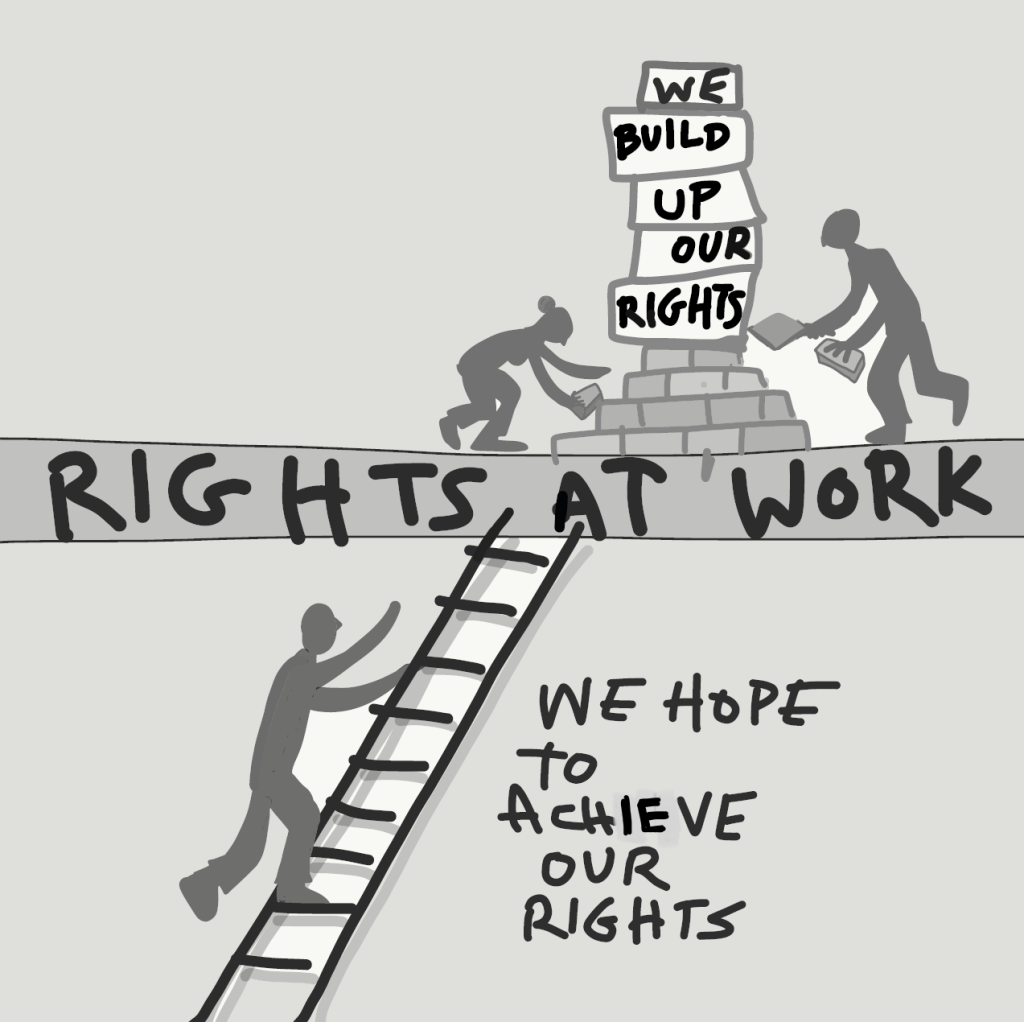
Activists should be pushing employers to improve their policies and practices. Many unions will have model policies and agreements that they are updating to reflect the new legislation. Employers who are on the ball will try to present improvements as the fruit of their generosity. Communicate to workers yourselves, so that they understand that what’s in the Act is the result of union pressure on the government, and that’s why your employer is improving its policies. If possible, involve workers in updating policies and pick some around which to campaign to exceed what’s in the Act, or to bring improvements in earlier.
In summary, the changes to individual rights already implemented are:
- Employees are eligible for unpaid paternity leave and unpaid parental leave from day one of employment. The restriction on taking paternity leave after shared parental leave has been removed.
- Whistleblowing about sexual harassment, defined as ‘unwanted conduct of a sexual nature has the purpose or effect of violating an individual’s dignity or creating an intimidating, hostile, degrading, humiliating, or offensive environment’ is now a ‘protected disclosure’. Confidentiality clauses are void if they attempt to prevent whistleblowing on sexual harassment. You can use this change to push for a broader end to confidentiality clauses rather than waiting for the government to do so.
- There are new entitlements to unpaid bereavement leave, including for pregnancy loss.
- Partners are entitled to up to 52 weeks of unpaid bereaved partners’ paternity leave if the mother or primary adopter dies within the first year of the child’s life.
- Statutory sick pay is available to all employees from their first day of sickness. However, the rate has been reduced for some low-paid workers.
This timeline from Morrish solicitors is useful for seeing what’s coming next, particularly since they update it periodically.
Rights are useless if workers don’t know about them. Improvements are a good excuse for unions to organise meetings to educate workers about their rights, ensure the employer doesn’t take the credit and recruit.
Union recognition
One route for workers to win the right to negotiate their pay and conditions collectively is via the ‘union recognition’ process set out in legislation. This has been simplified. The onerous and vague requirement to prove that the union is likely to win a majority in a recognition ballot before one can be held has been removed, as has the requirement that at least 40% of all the workers must vote ‘yes’. The government may reduce the requirement for unions to show 10% membership in order to start the process.
Just as important are the measures to counteract employer mischief. Employers can no longer rig ballots by hiring loads of extra staff just beforehand – new hires after an application is made are excluded from the ballot. Employers can’t prevent workers from winning recognition by recognising a union that isn’t independent, though there are sometimes ‘independent’ unions prepared to make deals over the heads of the workforce. From October 2026, there will be regulation of some other unfair practices in the recognition process.
The changes should make unions less hesitant about pushing for recognition. However, unless workers build enough power to extract concessions, the right to bargain can be meaningless. Organising efforts shouldn’t stop when recognition is won.
Enforcement
A new Fair Work Agency brings together responsibility for the enforcement of a range of legislation. This makes it easier for workers to assert some rights because the agency can bring employment tribunal cases on behalf of workers and provide legal assistance. At present, a significant proportion of employment tribunal applicants have had no legal representation. The fact that the agency will recover its costs from employers increases the deterrent for employers. But the range of rights covered is far too narrow, leaving enforcement to individuals in most cases.
Equality Action Plans
It is now voluntary for employers to develop and publish Equality Action Plans, including at least one action to address the gender pay gap and one to support employees through menopause. Plans will become mandatory for employers with 250 or more employees in 2027, but activists can push for them now, seek consultation about their content, and ensure they lead to real change. Many employers prefer to focus on increasing the diversity of more senior staff – breaking the glass ceiling – while leaving the majority of women stuck to the floor cleaning up shards of glass. Enforcement is via the Equality and Human Rights Commission (EHRC), which is so under-resourced that it will usually be up to workers to enforce through their own collective organisation.
Dismissals
The compensation, known as a ‘protective award’, for employees who haven’t been adequately consulted over their redundancy has increased from 90 to 180 days’ pay. This gives union representatives more leverage in the collective consultation process. Where employers dismiss and re-engage employees on worse terms, known as fire-and-rehire, this counts as a redundancy for the purposes of consultation. Compensation is increased by up to 25% if the employer broke the Code Of Practice covering fire-and-rehire.
Section 28 of the Act, which the government plans to introduce in January 2027, would introduce restrictions on fire and rehire, but with significant loopholes. Thompsons solicitors are warning unions to look out for employers trying to introduce variation clauses in contracts now, and to ensure that as many benefits are classed as pay as possible, rather than as expenses or benefits in kind, which won’t be as protected. The same section will introduce limited protection against your employer dismissing you to replace you with someone who isn’t an employee.
At some point in the future, the government may bring forward regulations to implement section 29 of the Act so that redundancies across a whole employer would count towards the threshold to trigger collective consultation. At present, employers can often evade consultation requirements by dividing redundancies into multiple smaller ‘establishments’.
The reduction in the minimum consultation period for large redundancies from 90 days to 45 days, which was implemented by the Tory-LibDem coalition in 2013, has not been reversed. This is important because many workplaces find it hard to ballot and take action within 45 days, enabling employers to dismiss workers before they can take lawful action.
Unions and industrial action
The Strikes (Minimum Service Levels) Act 2023, which allowed the government and employers to insist that workers scabbed on their own strikes but was never effectively used, has been repealed. The higher ballot turnout threshold for some ‘important public services’ has been scrapped, but the 50% ballot turnout threshold has not yet, and no timescale has been set.
The mandate from an industrial action ballot now lasts twelve months from when voting closes rather than six. We need to resist efforts to use this to make action even less intensive than before. In general, the more intensive the action, the more quickly you cause a crisis for the employer and the less action you actually need to take to achieve a result.
Dismissals for taking lawful industrial action are now automatically unfair, rather than this being restricted to the first twelve weeks of action. Together with the longer ballot mandate, this should mean strikers no longer need to reballot unless a strike is still going after nearly a year. From October 2026, there will be improvements to give a clearer right of union members to compensation if they suffer detriment short of dismissal for taking part in lawful industrial action.
Notice of industrial action has been reduced from fourteen days to ten, which is still higher than the seven that Labour promised. The process to ballot and take lawful action remains long and complicated. The requirements to have ‘picket supervisors’ with paperwork and to notify the police of pickets have gone.
Various changes reduce the administrative and financial burden on unions, but these don’t directly affect activists.
Workplace access
Rights of access to workplaces for unions aren’t due until October 2026, but as this has raised big hopes in some quarters, it is worth discussing. The draft Code Of Practice on union access to workplaces is now out for consultation, which means there is still a risk of it being watered down. The intention is that unions and employers will generally agree access arrangements ‘voluntarily’, with the Central Arbitration Committee (CAC) ruling on arrangements if that fails.
Access can mean both physical access and the ability to communicate with and provide information to workers directly or indirectly. Access won’t be allowed in ways that ‘unreasonably interfere’ with the employer’s business. Being given electronic access is not a valid reason for refusing physical access. The code says that the ‘employer’s typical methods of communicating with the workforce should be used as a benchmark’ – which typically means multiple methods, from email and phone calls to meetings.
There is a separate Code Of Practice covering access during a statutory union recognition process. The draft code says that the CAC ‘may’ refuse access where there is already a recognised independent union, despite this not being in the new section 70ZF (5) of the Trade Union and Labour Relations (Consolidation) Act. This is a major weakness. Lots of recognised unions have difficulty reaching non-members, particularly since Covid when hybrid and remote working became more common. Difficulties can be both physical (e.g. inability to gain entry to secure areas of a workplace) and digital (e.g. lack of information about who is in a workplace and how they can be reached). Unions should push to remove the exclusion of workers with recognised unions from the draft Code. If it remains in the final code, unions should test it without delay.
The right of access is for union ‘officials’, but this can include branch officers and workplace representatives, not just those employed by the union. The right cannot be used to organise industrial action. I can only be used for two purposes:
- to meet, support, represent, recruit or organise workers (whether or not they are members of a trade union)
- to facilitate collective bargaining
The fact that one of the purposes of access is to facilitate collective bargaining makes the exclusion of workers who already have union recognition particularly perverse – these are normally the only workers for whom that is relevant.
Update 27/05/2026: There are two further arguments against the draft Code Of Practice on access allowing applications to be rejected if any of the workers have union recognition. Firstly, many workplaces include workers with different employers and employment statuses. In practice, it is better for both unions and minimising disruption to the workplace if access can be coordinated across the whole workforce. A union may not even know that one worker for a subcontractor already has union recognition. Secondly, the current wording would encourage employers to seek out spineless unions with little or no membership to make recognition agreements that offer little to workers, to block genuine attempts by workers to organise. This could even include “unions” linked to the far right.
Update 22/07/2026: the draft Trade Unions (Right to Access Workplaces) Regulations 2026 have now been published. Section 13 (3) is much clearer than the Code of Practice on the right of a recognised union to gain access to workers. If the regulations are passed in this form this should resolve the issue.
Activists with union recognition should approach employers now and try to make voluntary access agreements that are at least as good as they would get by relying on the legislation.
The draft Code says that the CAC won’t grant access if the employer has fewer than 21 employees in total, though you can get access for a smaller workplace if the employer is big enough.
The process set out in the draft Code is slow and bureaucratic. I imagine that unions will discourage activists from making formal access requests, particularly because multiple overlapping requests can trigger them all being refused. Nonetheless, branches should start making plans now for what access requests they want for the employers they cover, so you can start discussing them with union staff and be ready for October.
If the employer breaks the rules, the union has to complain to the CAC, which can order the employer to facilitate access. If they don’t comply, the union has to complain to the CAC again, and the CAC can impose a fine. The draft code limits this to £75,000 for a first breach, £150,000 for a second, and £500,000 for a third or subsequent breaches. Unions will want their legal departments to deal with complaints, giving staff paid by the union, rather than workplace activists, control over the process.
Outsourcing
October 2026 is also expected to see the reinstatement and strengthening of the Code of Practice intended to prevent the growth of a two-tier workforce in outsourced public services. The idea is that a private sector employer shouldn’t be able to give new hires worse pay and conditions than staff who were outsourced from the public sector. Activists should keep a sharp eye out for employers trying to put arrangements in place before the new Code comes into effect.
Ian Allinson will be one of the speakers at an online meeting organised by Troublemakers At Work on 5 May 2026 to discuss ‘The Employment Rights Act: Shortcomings & Opportunities’.
Resources:
- Government timeline for implementation of the Act
- Morrish solicitors’ timeline
- Thompsons Solicitors’ Employment Rights Act hub
- Employment Rights Act 2025
- Government consultations